How can we help?
Fresh and Recycled Capital
Part of How Sharesight calculates your returns — the universal calculation reference for your portfolio, holdings, and reports.
Recycled capital is the proceeds received from selling an asset to buy the same or a new asset.
For capital to be considered recycled, the new investment's (or same investment) purchase date must be a day or more after the proceeds from the sale of the previous investment.
Sharesight excludes recycled capital from holding return to avoid understating return. For example, if you bought a stock with a capital of $10,000, sold it for $15,000 (a gain of $5,000) before buying again for $13,000. Sharesight only considered the invested capital as $10,000 because the 2nd purchase is funded by the proceeds.
Example
Let's use CBA.ASX as another example.
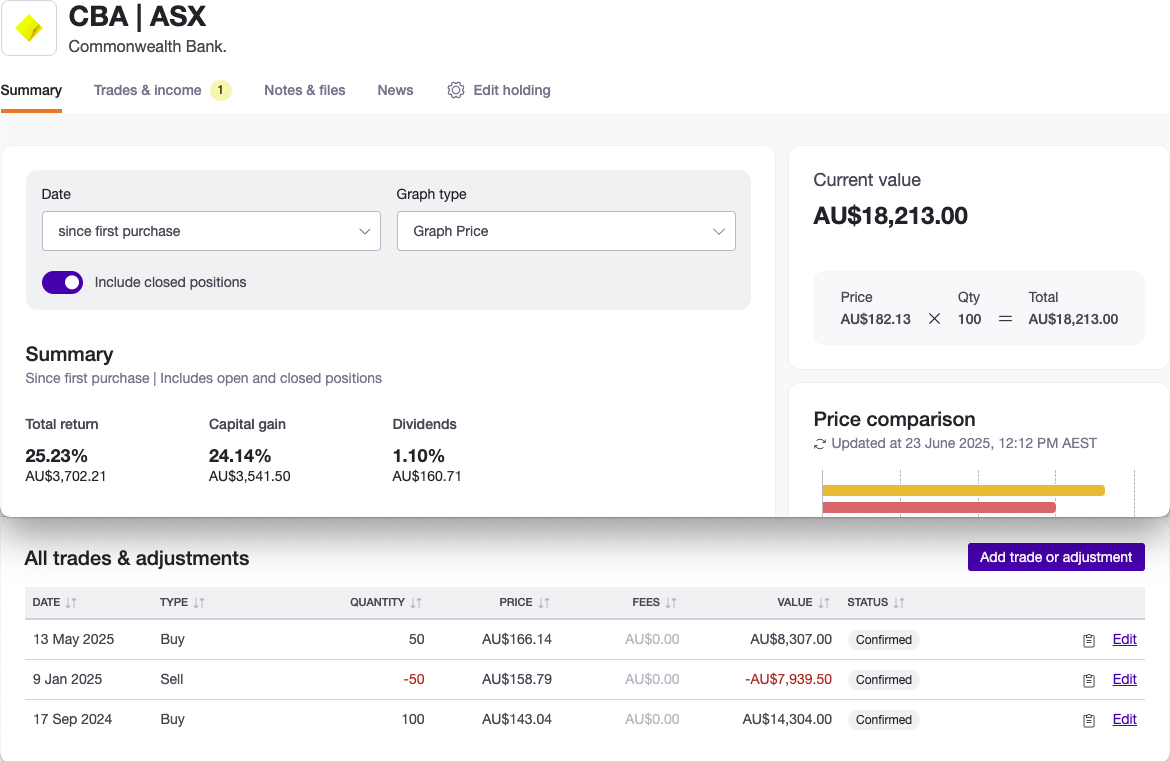
The capital return is 24.14%. That is calculated using a total capital gain of $3,541.50 and a total invested capital of $14,672.50.
3,541.50/14,672.50 = 24.14%
Where does $14,672.50 come from?
The first purchase has an invested capital of $14,304. While the second purchase has an invested capital of $8,307, which $7,939.50 is considered recycled and excluded. As a result, only $367.50 is added to derive the total invested capital of $14,672.50.
How fresh and recycled capital works at the portfolio level
The example above shows how fresh and recycled capital is calculated for an individual holding. At the portfolio level, the same idea applies, but the pool of recycled capital isn't limited to one holding — it's shared across your entire portfolio.
When you sell any holding, the proceeds become recycled capital available for your next purchase of any holding, not just a repurchase of the same one. Only the portion of a purchase that isn't covered by available recycled proceeds counts as new (fresh) invested capital for your portfolio's total return.
This follows the order in which your trades actually happened: proceeds from a sale are only available to fund purchases made after that sale settles.
A simple example
Say you buy Stock A for $10,000. You later sell Stock A for $15,000, then use $13,000 of those proceeds to buy Stock B — a completely different holding. At the portfolio level, the $13,000 purchase of Stock B is fully covered by the $15,000 in recycled proceeds, so no new capital was invested in your portfolio as a whole. Your portfolio's total invested capital is still the original $10,000, even though the money ended up in a different holding from the one it came from.
Last updated 22nd October 2026